Our Location
304 North Cardinal St.
Dorchester Center, MA 02124

304 North Cardinal St.
Dorchester Center, MA 02124

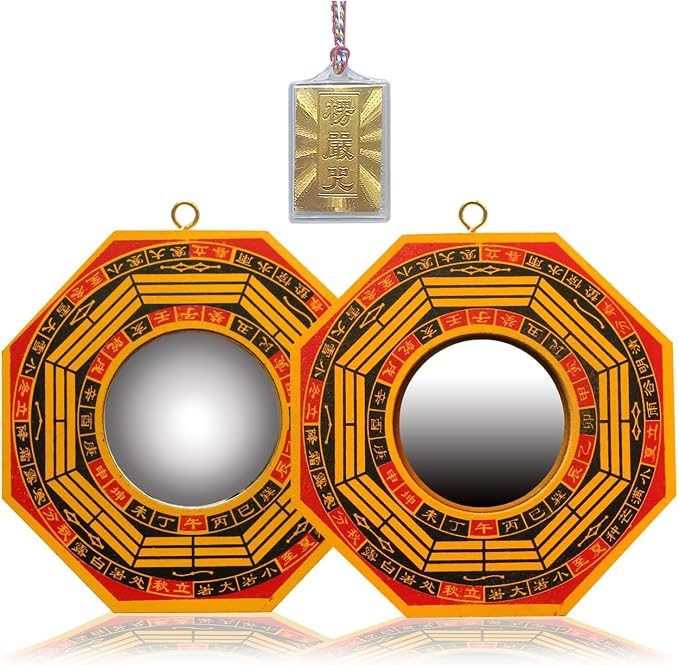
You may have heard of the Chinese Bagua Mirror. But what exactly is it for? What are the rules for hanging one? And why can a simple mirror spark disputes between neighbours? This article breaks down everything you need to know about the Bagua Mirror—from its types and symbolic meanings to a scientific perspective.
In this article,you will learn:
Simply put, a Bagua Mirror combines Bagua symbols with a bronze mirror. Rooted in ancient Chinese Feng Shui culture, it is regarded as a Feng Shui instrument that regulates environmental qi and mitigates adverse influences from the surroundings.
However, the Bagua Mirror is far more than mere decor, nor can it be casually hung as an auspicious ornament. Within Feng Shui principles, it functions more like an environmental remedy. It should only be deployed when the external layout of a residence creates disharmonious energy. The golden rule holds: use it only if problematic adverse energy exists; do not hang one when there are no negative influences. As a classic Feng Shui tool, its application comes with clear and strict guidelines.

General golden rule: All reflective Bagua mirrors follow this principle — hang only when negative sha exists, choose the correct type, and keep the mirror facing outwards. Never aim it towards neighbours’ doors or windows.
Condition 1 – There must be an actual “threat” outside your home
This isn’t about fixing bad vibes inside the house. You only consider it if, from your front door or main window, you’re directly facing something unpleasant outside — like a road that points straight at you, a sharp corner of a neighbor’s building, a utility pole, or a narrow gap between two buildings. It’s always about something physical outdoors, not an internal issue.
Condition 2 – You’ve already tried everything else to block it
Before hanging a mirror, ask yourself: can I just change where my door faces? Can I plant some bushes or build a small wall to screen it? If you can physically block or hide the view, do that first. The mirror is a last resort — only when you truly can’t avoid seeing it.
Condition 3 – It has to be a real, visible thing
This one is key. The mirror only works for objects you can actually see and point at — like a pole sticking up right in your line of sight, or a rooftop corner aimed at your door. It doesn’t apply to vague ideas like “bad energy” or “bad luck.” Only concrete, physical things count.
How to check if your home actually needs one:
Step 1 – Stand at your front door (or big front window) and look out
Look straight ahead. Do you see a road, an alley, or a hallway pointing directly at you? Is there a sharp corner, wall edge, or roof overhang aimed your way? Any utility poles, lampposts, or chimneys dead ahead? What about a narrow gap between two buildings lined up with your door? Or a staircase or elevator door facing yours?
Step 2 – Gauge the distance and how it makes you feel
If whatever you’re seeing is over 300 feet (about 100 meters) away, and there are trees, flower beds, or other buildings in between, you’re probably fine. But if it’s within 150 feet (about 50 meters), completely unobstructed, and standing there makes you feel uneasy or pressured — then it’s worth thinking about.
Step 3 – Ask yourself one honest question
“If I don’t hang this mirror, will I feel uncomfortable or unsettled every time I open the door and see that thing?”
If the answer is yes, then go ahead and consider it — because half the time, the mirror is really just helping you feel better about what you see. If it bothers you, that’s reason enough to use it.

Most people only ask “when should I hang it,” but they forget to ask “when should I NOT hang it” and “how do I hang it without causing problems.” Here’s the breakdown:
Taboo 1 – Never point the mirror directly at someone else’s door or window
This is the number one rule, and you absolutely cannot break it. A Bagua mirror works by “reflecting” things back. If you aim it straight at your neighbor’s front door, window, or balcony, you’re essentially pushing bad stuff into their home. It’s not just a huge no-no in feng shui – it’s also a great way to start a feud with your neighbor. They’ll feel like you’re “shooting” at them. The right way is to tilt it slightly so the reflection hits open space or the sky, not anywhere people actually live.
Taboo 2 – Never hang it indoors
A Bagua mirror is a tool for dealing with outdoor problems – it’s not a decoration for your living room. Hanging it inside (like in your hallway or bedroom) will actually pull outside negativity into your home, which is the opposite of what you want. It belongs strictly outside your front door or window, facing outward. If you don’t have a way to hang it outdoors, just skip it entirely. Don’t hang it inside.
Taboo 3 – If it’s been blessed, don’t mess with it
If your mirror has been consecrated or blessed by a priest, it’s no longer an ordinary object. Once it’s up, don’t casually touch the glass, don’t take it down to play with it, and don’t let it get dirty or smudged. Some traditions even say you shouldn’t hang laundry or pile clutter underneath it. Keeping it clean and undisturbed is the most basic way to show respect.
Taboo 4 – Replace it immediately if it’s cracked or damaged
If your Bagua mirror gets a crack, a chipped edge, or a foggy surface, it stops working – and might even backfire on you. So check on it once in a while (say, every six months). If you see any damage, replace it with a new one as soon as possible. And don’t just toss the old one in the trash – wrap it in red cloth before you throw it away.
Taboo 5 – Don’t hang more than one
One is plenty. Hanging multiple mirrors won’t give you “double protection” – it’ll just make your house look aggressive and unwelcoming. In feng shui, too much is just as bad as not enough. More mirrors cluttering up your entrance will not only look messy but also mess up the energy around your home.
Taboo 6 – Not every “threat” calls for a convex mirror
Bagua mirrors come in three types: flat, convex (bulging outward), and concave (curving inward). Using the wrong one is as bad as not using one at all – or worse.
If you’re not sure what you’re dealing with, your safest bet is a convex Bagua mirror – it’s the most versatile and the least likely to cause trouble.
1. Placement
Hang it above your front door or window, with the mirror facing outward, pointed in the direction you want to address. Tilt it slightly downward – don’t hang it perfectly flat. Make sure it’s secured firmly so it doesn’t blow off in the wind.
2. Height
Hang it high enough so that people walking by won’t see their own reflection when looking straight ahead. Generally, just keep it above eye level for most adults. This helps avoid drawing attention or causing misunderstandings.
3. Extra items
Some people hang a string of old Chinese coins beneath the mirror (a few inches apart) as a complementary touch. But this is entirely optional – the mirror works fine on its own.
4. Gentler alternatives
If you’re worried that hanging a mirror might make your neighbors feel uncomfortable or seem unusual, consider these lower-key options instead: