Our Location
304 North Cardinal St.
Dorchester Center, MA 02124

304 North Cardinal St.
Dorchester Center, MA 02124
You may have heard of China’s Bagua, or spotted bagua mirrors in Chinatown shops — but what exactly is the Bagua? Far from superstitious divination, it is a systematic framework of thought passed down over three thousand years. This article breaks down its meaning, evolution and practical applications in plain language.
In this article,you will learn
Bagua (Eight Trigrams) is a classic symbolic system passed down in Chinese culture for 5,000 years, originating from the ancient text I Ching (Book of Changes). Ancient ancestors observed all phenomena in nature and created this visual symbol steeped in Eastern philosophical thought. More than a tool for divination, it serves as an intellectual framework built upon the concept of Yin and Yang. It embodies the ancient understanding of the world: all existence maintains dynamic balance, follows cyclical patterns, and sustains endless vitality.
Rich in spiritual symbolism, the Bagua centers on the pursuit of balance, coexistence and harmony. Over thousands of years, this symbol has woven itself into traditional Chinese craftsmanship, architectural aesthetics and everyday culture. To this day, the Bagua stands as an iconic Eastern cultural totem. It carries humanity’s heartfelt aspiration for inner and outer equilibrium, peaceful surroundings, and fulfillment in all aspects of life.

The core principle of Bagua lies in the balance of Yin and Yang. Ancient Chinese ancestors established this entire symbolic system with two fundamental lines: the unbroken Yang line symbolizes strength, vitality, and fortitude, while the broken Yin line represents inclusiveness, nourishment, and gentleness. The free combination of these three lines forms eight basic trigrams, which correspond to eight essential natural elements in the universe and embody the fundamental forms and operating laws of all living things and phenomena on earth.
The complete Bagua system carries three core tenets of Eastern philosophy, which constitute its timeless cultural value. First, all things are in constant transformation; every existence in the world evolves dynamically through endless cycles. Second, unity of opposites; rigidity and softness, motion and stillness, as well as Yin and Yang, coexist interdependently and complement one another. Third, harmony between humanity and nature; humans live in unity with nature and follow its natural laws, achieving ultimate balance of the mind and body, living environment, and life momentum. This is the fundamental reason why the Bagua symbol has always conveyed positive, soothing and auspicious implications.
Each trigram corresponds to an exclusive natural element and carries unique positive symbolism, including vitality, stability, wisdom, and smooth progression. They serve as core creative inspiration for traditional craft design, cultural carving, and oriental decorative aesthetics.
1. Qian ☰|Heaven The pure Yang trigram. It symbolizes the celestial firmament and stands for perseverance, ambition, career growth, and noble support. It represents inner strength, creativity, and leadership.
2. Kun ☷|Earth The pure Yin trigram. It symbolizes fertile earth and embodies tolerance, steadfastness, lasting blessings, and family well-being. It signifies nourishment, protection, and wholeness.
3. Zhen ☳|Thunder Symbolizes awakening spring thunder. It represents new beginnings, vigorous vitality, and positive transformation after challenges. It stands for breakthrough growth and promising futures.
4. Xun ☴|Wind Symbolizes flowing wind. It conveys smooth progress, flexibility, and harmonious connections. It represents openness, inclusiveness, and incoming opportunities.
5. Kan ☵|Water Symbolizes endless flowing water. It embodies wisdom, adaptability, and sustained prosperity. It stands for calm perseverance and continuous vitality.
6. Li ☲|Fire Symbolizes radiant flame and bright daylight. It represents clarity, brilliant prospects, and uplifting fortune. It signifies passion, transformation, and new rebirth.
7. Gen ☶|Mountain Symbolizes steady mountains. It conveys integrity, stable foundations, and peaceful blessings. It represents inner resolve, protection, and stable livelihoods.
8. Dui ☱|Lake Symbolizes nourishing lake waters. It stands for joy, harmonious relationships, and fulfilling outcomes. It embodies gentleness, accommodation, and overall well-being.
For thousands of years, the Bagua symbol has been widely applied in traditional artifacts, cultural crafts, architectural decoration, and wellness accessories. Valued for both aesthetic beauty and profound cultural connotations, it has become a core symbol of Chinese cultural export. All related creations focus on energy balance, positive blessings, peaceful surroundings, and artistic embellishment. Free from superstitious implications, they perfectly fit international aesthetic and cultural cognition.
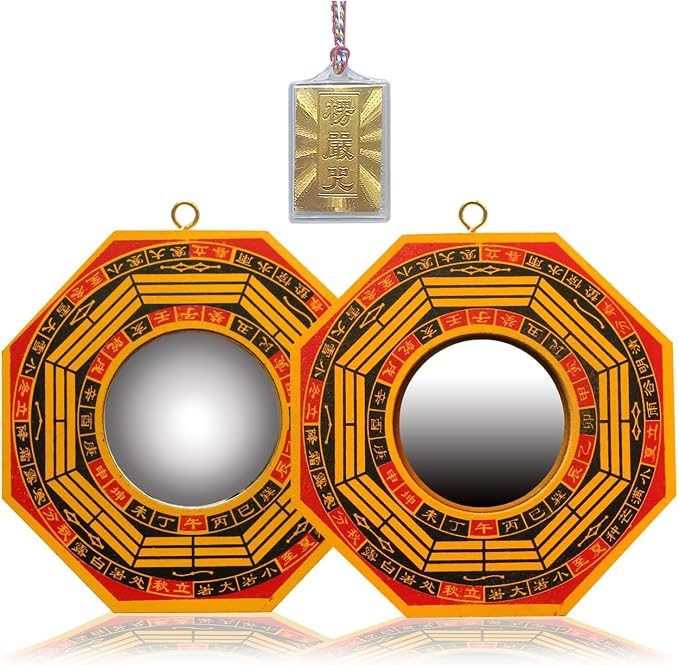
As one of the most recognized traditional Chinese ornaments, the Bagua Mirror features an octagonal frame engraved with complete trigram patterns. Available in flat, convex, and concave styles, it is a classic element of oriental spatial aesthetics. It symbolizes energy purification, spatial balance, and household tranquility. Widely used for home, store, and courtyard decoration, it represents clarity, peace, and smooth fortune, enjoying great popularity among global oriental art lovers.

Crafted from premium natural woods such as peach wood, boxwood, and ebony, these ornaments are delicately carved with Tai Chi and Bagua patterns. With elegant shapes and natural textures, they serve as exquisite decorations for desks, entryways, living rooms, and offices. They symbolize stable blessings, balanced energy, and steady progress. Combining ornamental value and collection significance, they are premium choices for Chinese craft exports.
The gourd is a traditional auspicious symbol in Chinese culture, perfectly matched with Bagua patterns. In Chinese tradition, the gourd symbolizes fortune, prosperity, and health. Combined with the balancing power of Bagua, it delivers double positive implications: blessing accumulation, safety protection, and harmonious energy. Compact and elegant, these pendants are ideal for home decoration, car accessories, and daily wear, suitable for diverse global consumption scenarios.
Inheriting millennia-old bronze craftsmanship, traditional bronze mirrors are engraved with Bagua and Chinese zodiac patterns. Originating as daily utensils and ritual vessels in ancient China, they are now valued art collectibles and decorative pieces. They symbolize purity, brightness, and year-round peace. With a warm and solid metallic texture, they possess high artistic and cultural heritage value.

Bagua patterns are widely adopted in traditional Chinese architecture, including ancient gardens, door lintels, beams, and window grilles. Ancient Chinese regarded architecture as a miniature universe, using Bagua motifs to echo cosmic balance and bless residences with stability and harmony. Today, these elements are extensively applied in neo-Chinese style courtyards, homestays, and tea rooms, presenting elegant and profound oriental charm.
Including Bagua pendants, bracelet accessories, decorative plaques, and art prints, these modern works integrate minimalist Bagua symbols with contemporary aesthetics. They abandon cumbersome traditional styles and present sleek, high-end oriental beauty. Symbolizing physical and mental balance, inner peace, and smooth daily life, they are trendy Chinese cultural favorites among young global audiences.
In the context of global cultural integration, Bagua has transcended folk customs and evolved into a representative symbol of oriental balanced aesthetics and Eastern philosophical wisdom. Its core concepts—dynamic balance, living in harmony with nature, and coexistence of all things—resonate perfectly with modern people’s pursuit of stability, peace, and inner discipline.
Featuring minimalist visuals, high recognizability, and universal positive implications, Bagua crosses cultural and regional barriers. It is widely used in Chinese export crafts, home décor, cultural gifts, and light luxury accessories. Carrying ancient Chinese blessings for nature, life, and the future, Bagua serves as a vital cultural bridge that spreads Eastern wisdom, oriental aesthetics, and the timeless pursuit of peace and prosperity to the world.