Bagua Mirror Placement: A Complete Guide for Home, Outdoor, and Office Use
If you’ve already bought a Bagua mirror but aren’t sure where to hang it, you’re not alone. Placement is the single most common question people have about this feng shui tool — and getting it wrong can cause more problems than it solves. This guide covers Bagua mirror placement for homes, outdoor areas, and offices, with practical rules you can apply right away.
What a Bagua Mirror Actually Does
Before talking about placement, it helps to understand why a Bagua mirror is used at all. The core function is deflection. The mirror surface faces outward toward a source of negative energy and reflects it away, protecting the stability of a home or workspace.
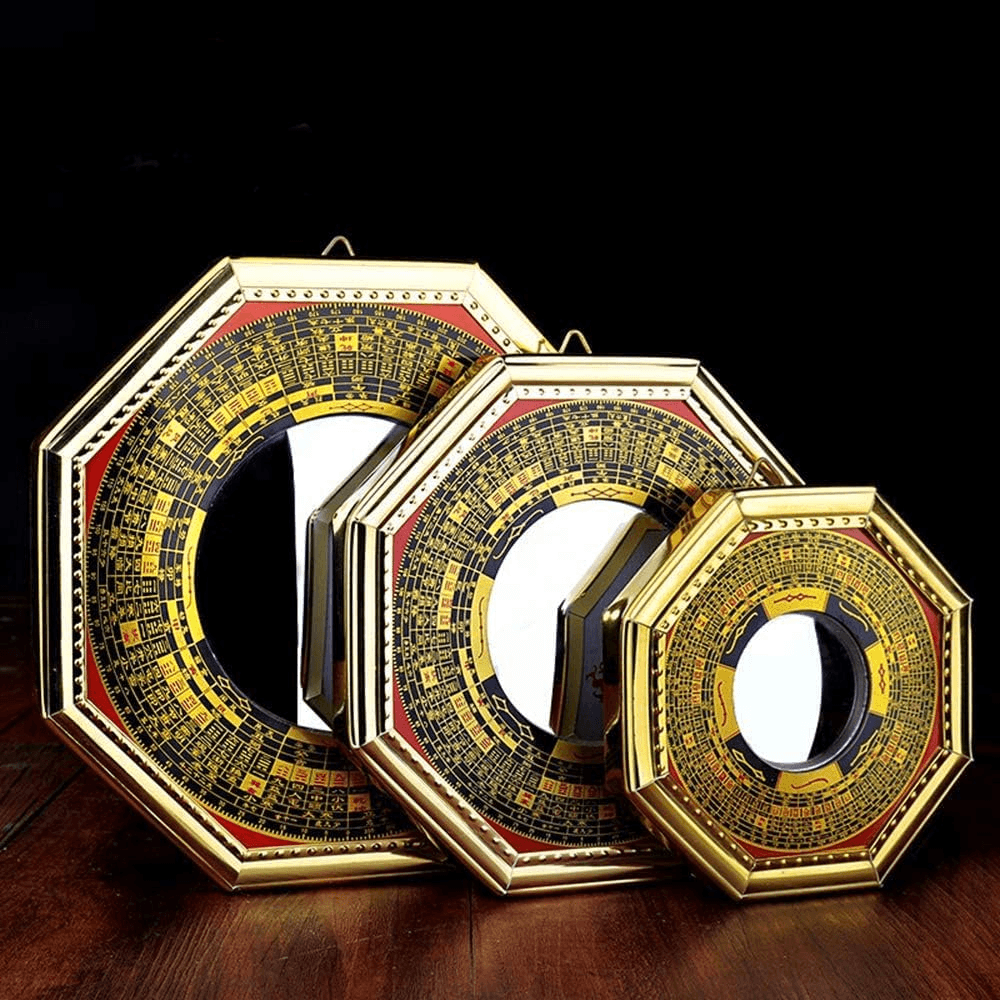
A traditional Bagua mirror has two parts: an outer ring of eight trigrams (the Bagua symbols) and a central mirror. The trigrams represent the underlying order of the universe, while the mirror does the actual work of reflection. Together they form a protective barrier in feng shui practice.
One important point: a Bagua mirror is a cure for existing problems, not a tool for attracting good fortune. It doesn’t generate positive energy on its own. It’s only used when there is a specific issue to address, which is why hanging one casually is not recommended.

Three Rules of hanging Bagua mirror
No matter where you hang it, three rules always apply.
First, the mirror faces outward, not inward. The reflective side must point toward the source of negative energy, which is usually outside. If the mirror faces into your home, it reflects that energy back inside.
Second, never point it at a neighbor’s door or window. This is the most common mistake. Aiming a Bagua mirror at a neighbor’s entrance redirects the problem toward them, which is both inconsiderate and a frequent source of conflict.
Third, never point it at people. Avoid hanging a Bagua mirror directly across from where someone sits, sleeps, or works for long periods.
With those rules in mind, here’s where a Bagua mirror is typically placed.
Outdoor Placement: Where a Bagua Mirror Works Best
Above the Front Door
The front door is the main entry point for energy into a home. A Bagua mirror is traditionally hung above the front door when it faces one of the following:
- An elevator that opens directly toward your door
- A staircase that runs downward toward your entrance
- A road that runs straight at your house (often called a T-junction)
- A sharp corner or edge of another building
- A utility pole or transformer
Hang the mirror facing outward, aimed at the source. The height should be slightly above the door frame, not lower.
Balconies and Windows
A Bagua mirror may also be hung on a balcony or window if it faces:
- A narrow gap between two tall buildings
- A curved road where the outer edge points toward your home
- A hospital, funeral home, or similar location associated with heavy negative energy
One caution: if the balcony is your main source of natural light, hanging a mirror there will block light and hurt the comfort of the space. In that case, consider alternatives like plants or a screen instead.
When Not to Hang a Bagua Mirror Outdoors
- If there’s no clear source of negative energy nearby, you don’t need one.
- If it would face a neighbor’s door or window, don’t hang it.
- If your building rules prohibit hanging objects outside, don’t hang it.
Indoor Placement: Use With Caution
A Bagua mirror is generally not recommended indoors, because its reflective function can create confusion in a closed space. But there are limited situations where it may be appropriate.
When Indoor Use Makes Sense
Only consider an indoor Bagua mirror when the issue comes from inside the home itself, such as:
- A bedroom door facing a bathroom door
- A bedroom door facing a kitchen door
- A long hallway running straight into a room
In these cases, use a flat Bagua mirror (not convex or concave), hung facing the source of the problem, not facing people.
Indoor Rules to Follow
- Do not hang it in a bedroom, especially across from the bed.
- Do not hang it directly across from the living room sofa.
- Do not hang it in the dining room or near kitchen work areas.
- Do not use convex or concave mirrors indoors — convex reflects too strongly, and concave absorbs scattered energy.
If the indoor issue is mild, use a screen, door curtain, or plant first. A Bagua mirror should be a last resort.

Feng Shui Mirror Placement in the Office
Office feng shui follows different logic from home feng shui, because an office is a shared space involving coworkers and career dynamics. Using a Bagua mirror at work requires extra care.
When It May Be Appropriate
- Your desk faces a bathroom door
- Your desk faces a long hallway
- Your desk faces an elevator
- Your back is exposed to a window or walkway
In these situations, a small Bagua mirror can be placed near your desk, with two conditions: the mirror faces the source of the problem, not a coworker, and the size stays small.
Office Rules to Follow
- Do not hang it in shared areas like meeting rooms or break rooms.
- Do not point it at a coworker’s desk.
- Do not point it at your manager’s office door.
- If your workplace prohibits personal decorations or feng shui items, respect that rule.
In most office settings, simpler solutions work better: a small screen behind your chair, a plant on your desk, or a change in seating direction. A Bagua mirror should be the last option, not the first.
Convex, Concave, and Flat: Which One to Use
Many people are unsure which type of Bagua mirror to buy. Here’s the practical difference:
- Convex mirror: The surface bulges outward. It has the strongest reflective power and is used for strong negative energy, such as a road pointing straight at your home or a sharp building corner. Typically hung outdoors.
- Concave mirror: The surface curves inward. It absorbs energy rather than reflecting it. It’s sometimes used to collect energy, but it can also absorb scattered or unwanted energy if used incorrectly. Not recommended for beginners.
- Flat mirror: Gentle reflection. Suitable for indoor use, such as a door facing another door.
For most homes, the safe choice is convex outdoors, flat indoors. Concave mirrors are best avoided unless you have specific guidance.
Common Questions About Bagua Mirror Placement
Do I need to have the mirror blessed?
Some practitioners recommend a blessing or consecration before use. If you don’t follow a specific spiritual tradition, keeping the mirror clean and treating it with respect is enough.
How many Bagua mirrors can I hang?
One per home is usually enough. More than three is not recommended, as it can create a confused energy environment.
What if the mirror gets dirty?
Wipe it with a clean, soft cloth. Avoid chemical cleaners and rough materials that could scratch the surface.
Can I hang a Bagua mirror if I rent my apartment?
Yes, but consider removable hooks or placing a small flat mirror on a shelf rather than drilling holes. If your lease prohibits wall damage, a freestanding option works just as well.
Do I need more than one mirror if I have several problems?
Address the most serious issue first. In most cases, one well-placed mirror is more effective than several scattered around the home.
A Simple Way to Decide Where to Hang It
If you’re still unsure, follow this sequence:
- Identify whether there is a clear source of negative energy — a road, a sharp corner, an elevator, a hallway.
- Confirm that the source is outside your home or office, or comes from a structural feature inside.
- Choose the right mirror type: convex for outdoor use, flat for indoor use.
- Hang it facing the source, never facing people or a neighbor’s entrance.
- If no clear source exists, don’t hang one at all.
The most important principle in Bagua mirror placement is simple: the mirror faces the source of the problem, not a fixed compass direction. Direction matters only in relation to where the negative energy is coming from.
Final Thoughts
Bagua mirror placement comes down to one core rule: face the mirror toward the source of negative energy, and never point it at people, neighbors, or the inside of your home. Everything else — indoor versus outdoor, convex versus flat, home versus office — follows from that principle.
If you’re unsure whether you need a Bagua mirror at all, take a walk around your home or workspace and look for obvious sources of negative energy. If there aren’t any, you don’t need one. If there are, use this guide to choose the right placement.
Feng shui tools are meant to support a healthy environment, not replace common sense. A well-lit, clean, and comfortable space does more for your well-being than any mirror ever will.