Chinese Zodiac: The 12 Animals, Years, Meanings & Compatibility
The Chinese zodiac is a traditional system that assigns one of 12 animals to each year in a repeating cycle. These Chinese zodiac animals—Rat, Ox, Tiger, Rabbit, Dragon, Snake, Horse, Goat, Monkey, Rooster, Dog, and Pig—are an important part of Chinese culture, folklore, and Lunar New Year celebrations.
Your Chinese zodiac sign is traditionally determined by your birth year, although people born in January or February may need to check the exact date of Chinese New Year. Each zodiac animal has its own symbolic meanings, traditional personality traits, and cultural associations.
In this guide, you will discover the 12 Chinese zodiac signs in order, explore the Chinese zodiac years chart, learn how the five elements influence the zodiac cycle, and understand traditional zodiac compatibility.
- What is the Chinese Zodiac?
- What Are the 12 Chinese Zodiac Animals in Order?
- Chinese Zodiac Years Chart
- How to Find Your Chinese Zodiac Sign by Birthday
- Chinese Zodiac Personality Traits and Meanings
- Chinese Zodiac Compatibility
- The Five Elements and the Chinese Zodiac
- Chinese Zodiac Traditions and Cultural Beliefs
- Frequently Asked Questions
What Is the Chinese Zodiac?
The Chinese zodiac, known in Chinese as Sheng Xiao (生肖), is a traditional calendar system based on a repeating 12-year cycle. Each year corresponds to a different animal, creating a sequence that repeats every 12 years.
Unlike Western astrology, which commonly associates zodiac signs with the month and day of birth, the Chinese zodiac primarily associates a person’s sign with their birth year. Traditional Chinese astrology also incorporates other factors, including the five elements, the lunar calendar, and the system of Heavenly Stems and Earthly Branches.
Chinese Zodiac vs. Western Zodiac
The main difference between the Chinese zodiac and Western zodiac is how their signs are assigned.
- Chinese zodiac: Based primarily on the year of birth, with 12 animal signs.
- Western zodiac: Usually based on the month and day of birth, with 12 signs such as Aries, Taurus, and Gemini.
- Chinese zodiac elements: Wood, Fire, Earth, Metal, and Water add another layer to traditional interpretations.
Both systems have cultural and historical significance, but they follow different methods of classification.
The Origin of the 12 Chinese Zodiac Animals
One popular Chinese zodiac legend tells the story of a Great Race organized by the Jade Emperor. Animals competed to determine their order in the zodiac cycle. The Rat famously secured first place, followed by the Ox, Tiger, Rabbit, Dragon, Snake, Horse, Goat, Monkey, Rooster, Dog, and Pig.
This story is a traditional folk legend rather than a verified historical account. It remains a popular way to explain the order of the 12 zodiac animals.
What Are the 12 Chinese Zodiac Animals in Order?
The 12 Chinese zodiac animals each carry distinct symbolic meanings in traditional Chinese culture. The following list introduces their order and commonly associated characteristics.
- Rat (鼠): Often associated with intelligence, adaptability, resourcefulness, and quick thinking.
- Ox (牛): Symbolizes diligence, patience, reliability, and perseverance.
- Tiger (虎): Represents courage, confidence, strength, and independence.
- Rabbit (兔): Associated with gentleness, diplomacy, elegance, and sensitivity.
- Dragon (龙): Symbolizes power, ambition, vitality, and good fortune.
- Snake (蛇): Often linked with wisdom, intuition, thoughtfulness, and mystery.
- Horse (马): Represents energy, freedom, enthusiasm, and independence.
- Goat or Sheep (羊): Associated with kindness, creativity, compassion, and harmony.
- Monkey (猴): Symbolizes curiosity, cleverness, versatility, and playfulness.
- Rooster (鸡): Represents confidence, punctuality, attention to detail, and diligence.
- Dog (狗): Associated with loyalty, honesty, responsibility, and fairness.
- Pig (猪): Often linked with generosity, sincerity, comfort, and optimism.
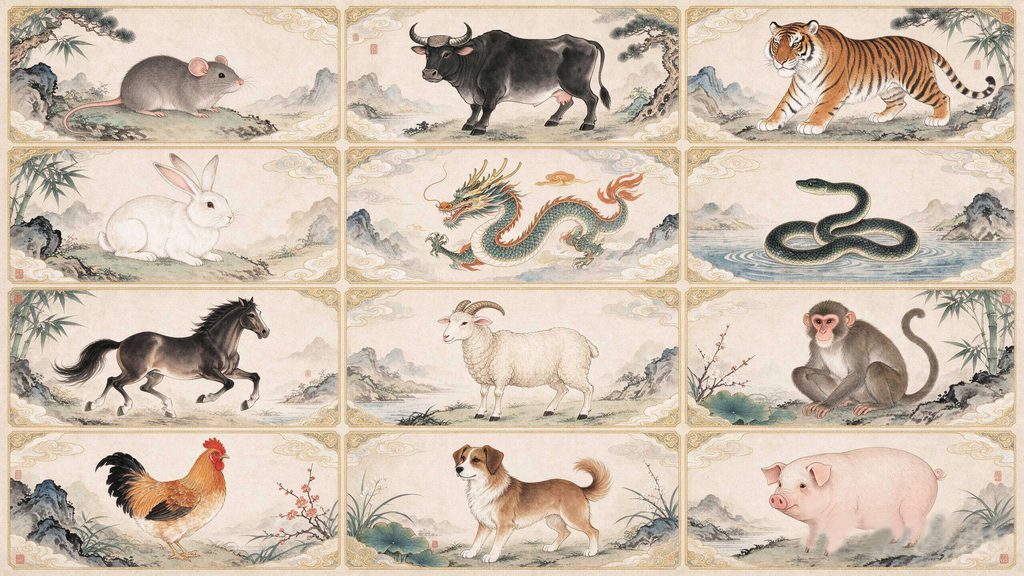
These descriptions reflect traditional cultural interpretations, not scientifically established personality traits. Individual personalities are shaped by many factors beyond a person’s zodiac sign.
Chinese Zodiac Years Chart
The Chinese zodiac year chart helps you identify your animal sign by birth year. Because the 12-year cycle repeats, people born 12 years apart generally share the same zodiac animal.
| Zodiac animal | Example birth years |
|---|---|
| Rat | 1948, 1960, 1972, 1984, 1996, 2008, 2020 |
| Ox | 1949, 1961, 1973, 1985, 1997, 2009, 2021 |
| Tiger | 1950, 1962, 1974, 1986, 1998, 2010, 2022 |
| Rabbit | 1951, 1963, 1975, 1987, 1999, 2011, 2023 |
| Dragon | 1952, 1964, 1976, 1988, 2000, 2012, 2024 |
| Snake | 1953, 1965, 1977, 1989, 2001, 2013, 2025 |
| Horse | 1954, 1966, 1978, 1990, 2002, 2014, 2026 |
| Goat or Sheep | 1955, 1967, 1979, 1991, 2003, 2015, 2027 |
| Monkey | 1956, 1968, 1980, 1992, 2004, 2016, 2028 |
| Rooster | 1957, 1969, 1981, 1993, 2005, 2017, 2029 |
| Dog | 1958, 1970, 1982, 1994, 2006, 2018, 2030 |
| Pig | 1959, 1971, 1983, 1995, 2007, 2019, 2031 |
Important: This chart provides representative Gregorian birth years, not exact date boundaries. Chinese zodiac years do not always begin on January 1. If you were born in January or February, check the Chinese New Year date for your birth year before deciding which zodiac animal applies.
How Often Does Each Chinese Zodiac Animal Repeat?
Each zodiac animal returns every 12 years. For example, the Year of the Dragon includes 1988, 2000, 2012, and 2024, while the Year of the Snake includes 1989, 2001, 2013, and 2025.
However, the zodiac cycle also interacts with the traditional five elements. This produces a broader 60-year cycle, meaning that the same animal-element combination repeats every 60 years.
How to Find Your Chinese Zodiac Sign by Birthday
Finding your Chinese zodiac sign is usually straightforward: identify your birth year and match it to the corresponding animal. However, your exact birth date matters if you were born near the beginning of the calendar year.
Why Chinese Zodiac Years Do Not Start on January 1
Chinese New Year, also called the Lunar New Year or Spring Festival, falls on a different Gregorian calendar date each year, usually between late January and mid-February.
For example, someone born in early February might belong to the previous zodiac year if Chinese New Year has not yet occurred. Simply looking at the Gregorian birth year can therefore lead to an incorrect result.
Some traditional Chinese astrology systems use the solar-term calendar, particularly Li Chun (Beginning of Spring), to determine certain astrological year boundaries. The appropriate method depends on the tradition being followed.
How to Check Your Zodiac Sign
Follow these steps to identify your Chinese zodiac animal:
- Find your full date of birth.
- Check the Chinese New Year date for that year.
- Determine whether your birthday falls before or after the relevant zodiac year boundary.
- Match the resulting year to the 12 Chinese zodiac animals.
If your birthday falls in January or February, use a reliable Chinese zodiac calculator or a date-specific zodiac chart instead of relying on the birth year alone.
Chinese Zodiac Personality Traits and Meanings
Chinese zodiac personality descriptions are a popular part of traditional astrology. Each animal has symbolic characteristics that people use to explore relationships, cultural traditions, and personal identity.
The Rat is traditionally considered resourceful and adaptable, while the Ox symbolizes patience and hard work. Tigers represent courage, and Rabbits are associated with diplomacy. Dragons carry powerful and auspicious symbolism, while Snakes are often connected with wisdom and intuition.
Horses represent energy and independence. Goats are associated with creativity and compassion, while Monkeys symbolize cleverness and curiosity. Roosters are linked with diligence, Dogs with loyalty, and Pigs with generosity.
These meanings vary across traditions and interpretations. They can provide an interesting way to explore Chinese cultural heritage, but they should not be treated as definitive descriptions of an individual’s character or future.
Chinese Zodiac Compatibility
Chinese zodiac compatibility is a traditional approach to interpreting relationships between different animal signs. It is often discussed in the context of romantic partnerships, friendships, and family relationships.
In traditional interpretations, certain signs are considered especially harmonious. Rat and Ox, Tiger and Pig, Rabbit and Dog, and Dragon and Rooster are examples of pairs often described as compatible.
Other traditional systems group the 12 animals into four harmonious trios:
- Rat, Dragon, and Monkey
- Ox, Snake, and Rooster
- Tiger, Horse, and Dog
- Rabbit, Goat, and Pig
These groupings are commonly used in traditional zodiac compatibility discussions, although interpretations differ among schools of Chinese astrology.
Zodiac Compatibility in Love and Relationships
Some people consult Chinese zodiac compatibility when exploring romantic relationships or marriage traditions. However, a zodiac pairing should not determine whether a relationship is successful.
Communication, mutual respect, shared values, emotional maturity, and trust are much more meaningful factors in real relationships. Zodiac compatibility is best understood as a cultural tradition rather than a scientifically validated relationship assessment.
The Five Elements and the Chinese Zodiac
The five elements—Wood, Fire, Earth, Metal, and Water—are another important part of traditional Chinese cosmology. They are used alongside the zodiac animals to create more detailed interpretations.
Each element has symbolic associations:
- Wood: Growth, creativity, and development.
- Fire: Passion, energy, and transformation.
- Earth: Stability, practicality, and balance.
- Metal: Discipline, determination, and structure.
- Water: Adaptability, intuition, and flexibility.
The elements interact with the zodiac cycle through the traditional Heavenly Stems and Earthly Branches system. Together, these form a 60-year cycle rather than a simple repetition of the 12 animals.
For example, 2024 was associated with the Wood Dragon, 2025 with the Wood Snake, and 2026 with the Fire Horse in the traditional sexagenary cycle. These combinations add cultural context to annual zodiac interpretations.
Chinese Zodiac Traditions and Cultural Beliefs
The Chinese zodiac continues to play a role in Lunar New Year celebrations, decorations, gifts, and popular culture. Zodiac animals frequently appear in calendars, artwork, greeting cards, and festive displays.
Another traditional concept is Ben Ming Nian (本命年), the year associated with a person’s own zodiac animal. In some Chinese cultural traditions, this year is believed to bring particular challenges or transitions. Customs such as wearing red clothing or accessories are sometimes observed for good fortune.
These practices vary by family, region, and personal belief. They are part of a broader cultural heritage rather than universal rules followed by everyone.
Understanding the Chinese zodiac therefore involves more than identifying an animal. It also offers a window into traditional symbolism, folklore, calendar systems, and the cultural significance of the Lunar New Year.
Frequently Asked Questions About the Chinese Zodiac
What are the 12 Chinese zodiac animals in order?
The 12 Chinese zodiac animals in order are Rat, Ox, Tiger, Rabbit, Dragon, Snake, Horse, Goat, Monkey, Rooster, Dog, and Pig. The cycle repeats every 12 years.
How do I find my Chinese zodiac sign?
Match your birth year to the Chinese zodiac years chart. If you were born in January or February, check the Chinese New Year date for your birth year to confirm your animal sign.
Does the Chinese zodiac change on January 1?
No. Chinese zodiac year boundaries generally follow Chinese New Year, which usually falls between late January and mid-February. Some traditional astrology systems use a different boundary, such as Li Chun.
What is the Chinese zodiac animal for 2026?
2026 is the Year of the Horse, specifically the Fire Horse in the traditional sexagenary cycle. The Lunar New Year begins on February 17, 2026.
What is the Chinese zodiac animal for 2027?
2027 is the Year of the Goat, also commonly called the Sheep in English. The Lunar New Year begins on February 6, 2027.
Are Chinese zodiac personality traits scientifically proven?
No. Traditional zodiac personality descriptions are cultural and astrological interpretations, not scientifically established methods for predicting personality, compatibility, or future events.
Explore the 12 Chinese Zodiac Signs
The Chinese zodiac offers a fascinating introduction to Chinese traditions, symbolism, and calendar history. Whether you want to find your Chinese zodiac animal, check a birth year, explore traditional personality meanings, or learn about zodiac compatibility, understanding the 12-year cycle is a useful starting point.
Explore each animal sign, compare the Chinese zodiac years chart, and learn how the five elements add another dimension to this enduring cultural tradition.